What Exactly is the Latissimus Muscle?
Today I thought I'd elaborate on a question we often receive when teaching certification courses... "What IS the Latissimus muscle?"
Of course, I love this question so much because it's another opportunity to teach dancers about their bodies, their instruments and how to tune into the sensation of the step rather than just how it looks (organic vs aesthetic Alignment).
We talk about this muscle whenever we teach dancers how to access stronger dance posture when arms are at shoulder height and how to maintain the beautiful shape (no droopy elbows) when doing steps like the Single Bump, Shimmy, and Hip Twist to name a few.
The secret to those gorgeous, strong arms doesn't actually start in the arms. They start in your back, with a big, beautiful muscle called the latissimus dorsi.
The latissimus dorsi (or "lats" for short) is the widest muscle in your entire body. It spans from your low back and the top of your pelvis, sweeps up along your spine and ribs, and attaches all the way up to your upper arm bone. Take a moment to picture that: a single muscle connecting your arm to your hips.
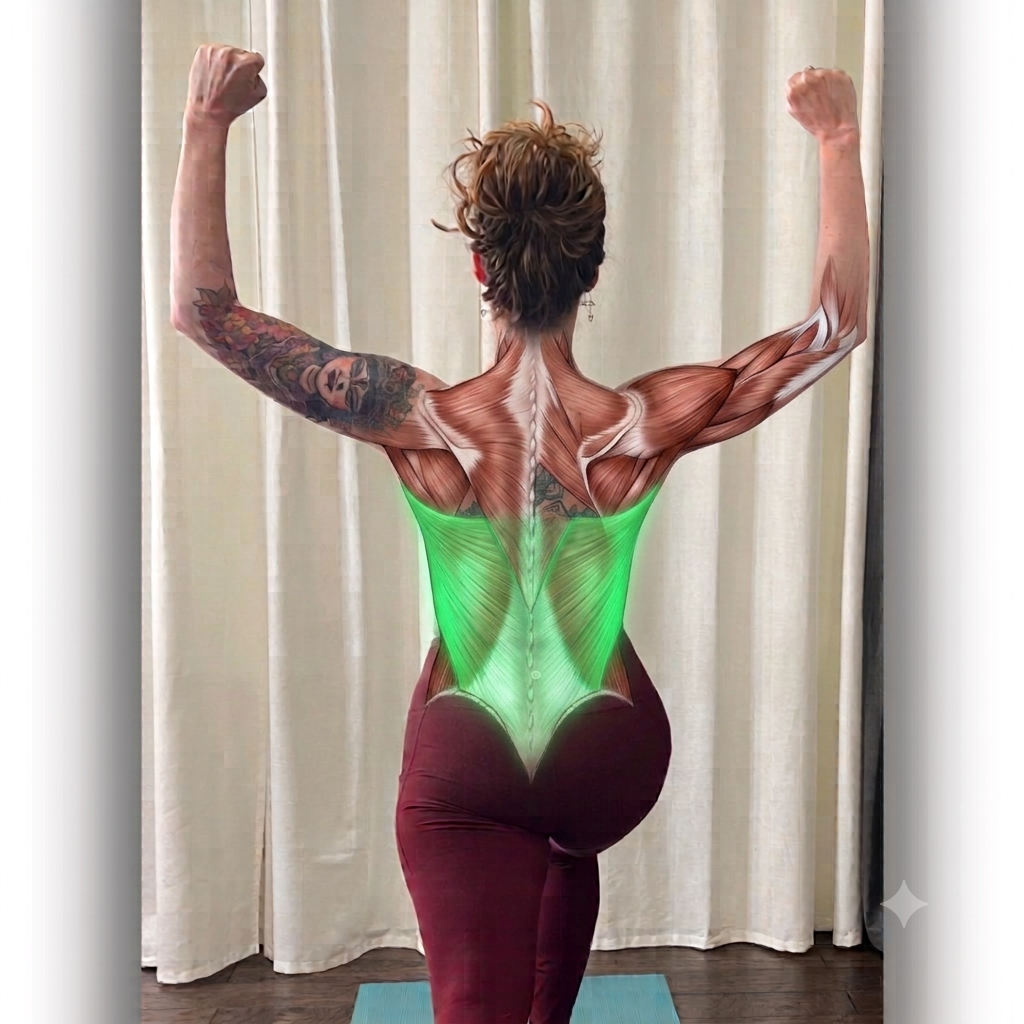
That's the big insight for us as dancers. Your arms are never really isolated. Every arm pathway you dance is connected, through the lats, to your low back and even your hips. This huge muscle basically impacts your entire dance vocabulary.
Now that you know what the lats are, let's look at what they DO.
Draw your arms down and back toward your body. Examples: Swivel Step arms, bringing arms down from overhead, and pulling the arm back as the same-side hip moves forward, as in the Single Bump.
Helps rotate the upper arm. Examples: Arm undulations, bringing arms to shoulder height, and any time our elbows are lifted (eh-hem... always).
Stabilize your spine and pelvis while you move. Hello Posture and isolations!
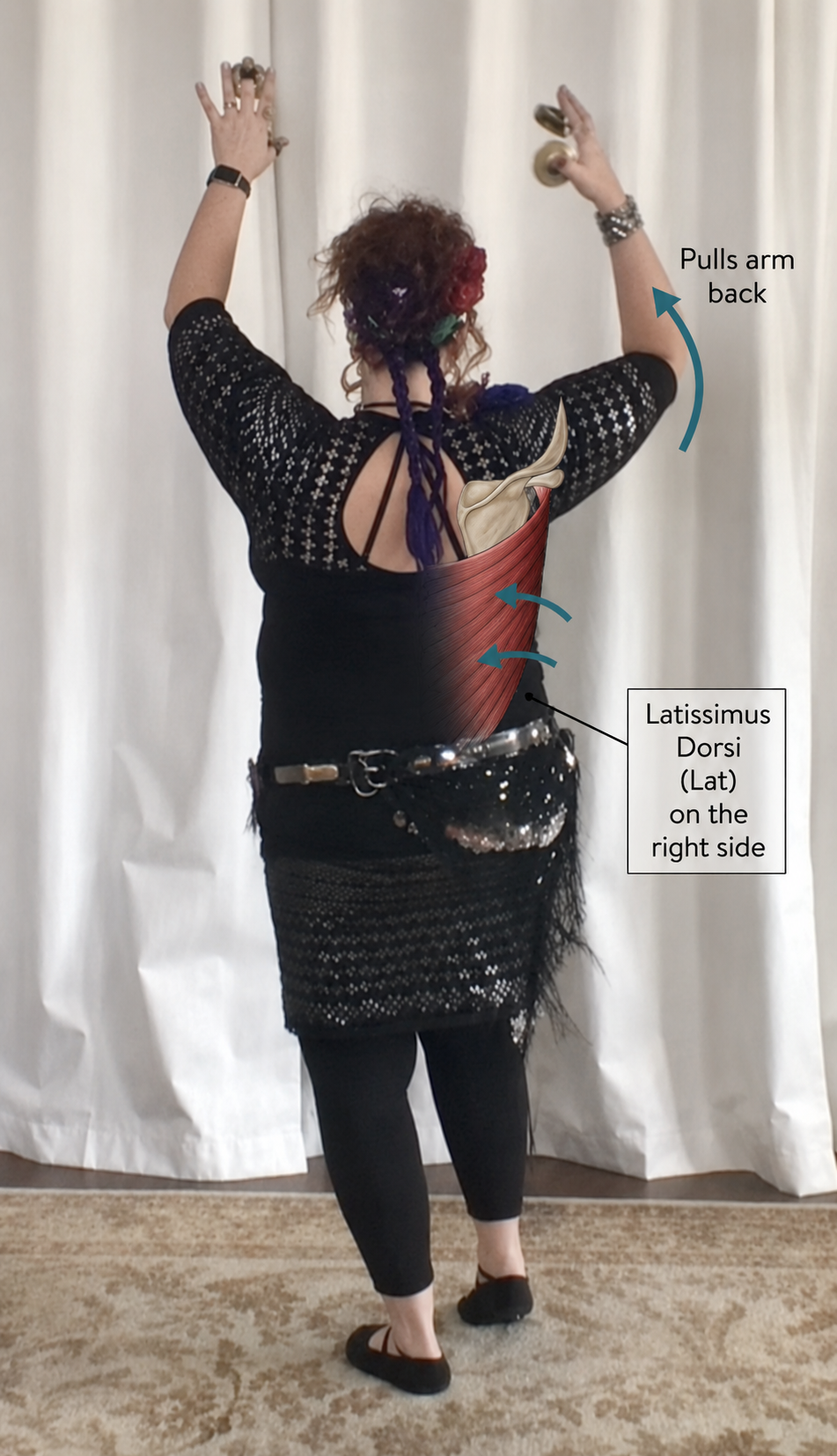
Example of right arm pulling back in the Swivel (Egyptian) Step
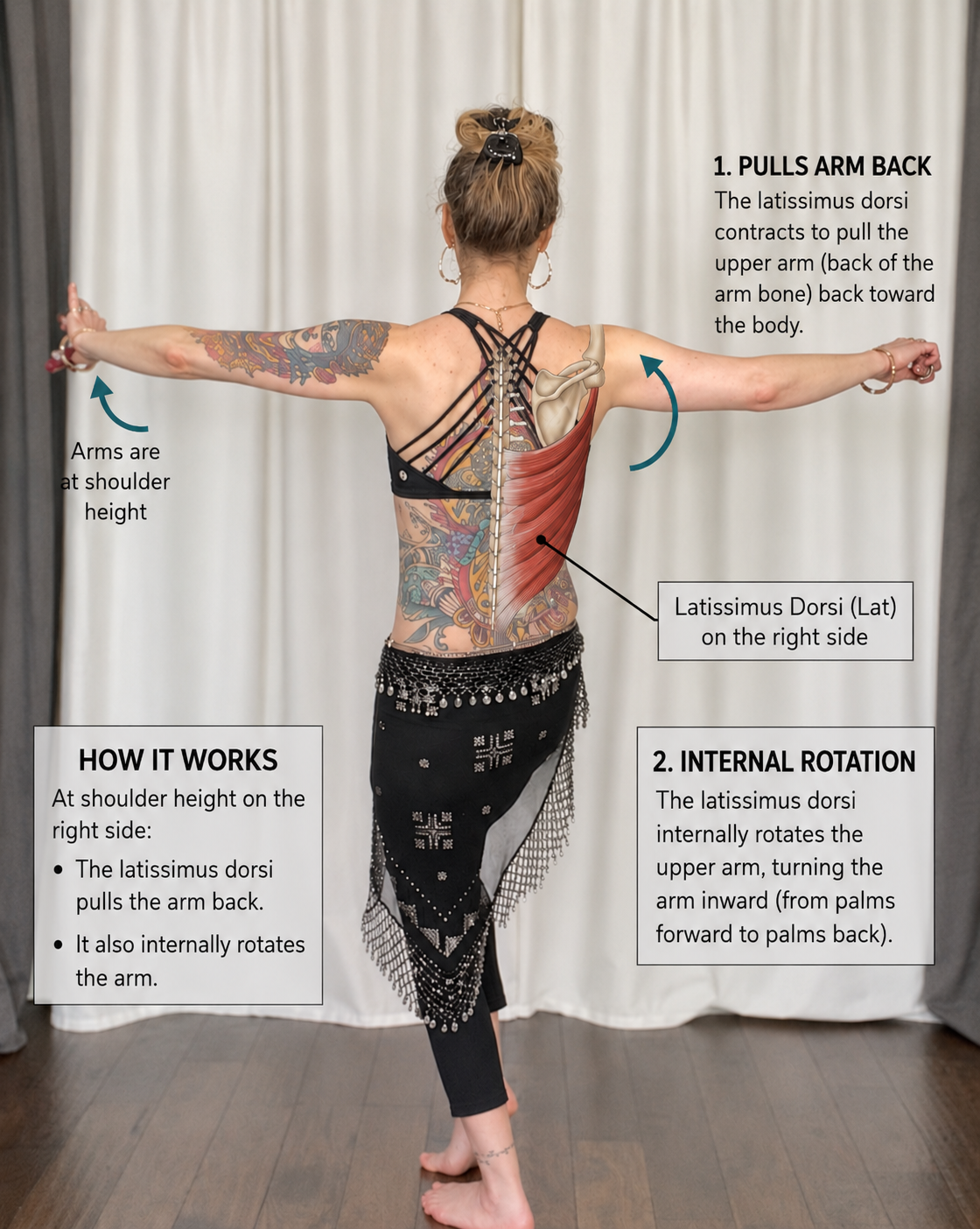
Example of right arm stabilizing and internally rotating as the right hip bumps forward in Single Bump
Why This Matters for Your Arms in Dance
The lats anchor the arms into the back body so the smaller muscles of the neck and shoulders don't have to do all the work.
In FCBD® Style, we hold our arms at or above shoulder height for long stretches of time. If you're lifting your arms "from the shoulders," the upper trapezius and smaller upper arm muscles take over, and that's when you get tension in the neck, raised shoulders, and arms that get tired quickly.
When the lats are engaged, something wonderful happens:
Your shoulder blades settle down your back. This creates that long, elegant neck and lifted chest we love in classic FCBD® Style posture. Grounded, but lifted.
Your arms get support from below. Instead of hanging from tired shoulders, your arms are held up by a broad web of muscle connected to your torso. This is how we maintain beautiful arm posture through an entire set without strain. Like setting your arms down on a shelf rather than hanging them up by strings.
Your movement becomes integrated. Because the lats tie into the connective tissue of your low back, your arm pathways can be powered by your whole torso. This is why arms feel so much more fluid and connected when the back body is active, the movement isn't coming from the arm alone, it's coming from a much larger, supportive part of your body.
Let’s Feel It!
Try this to connect with your lats:
Stand in your dance posture with your arms overhead. Now imagine you're pressing your upper arms down to shoulder height against water. Feel the resistance. Do you feel that subtle engagement along the sides of your back and behind your armpits? Hello, lats!
Another cue I love: From dance posture, bring your attention to the tips of your shoulders. Imagine reaching those points to the sides of the room, essentially elongating along your collarbone.
Notice how your neck lengthens and your chest opens, and it feels like you are "fanning out" your entire upper back without any gripping or forcing. That's your lats (with some help from friends) doing their job.
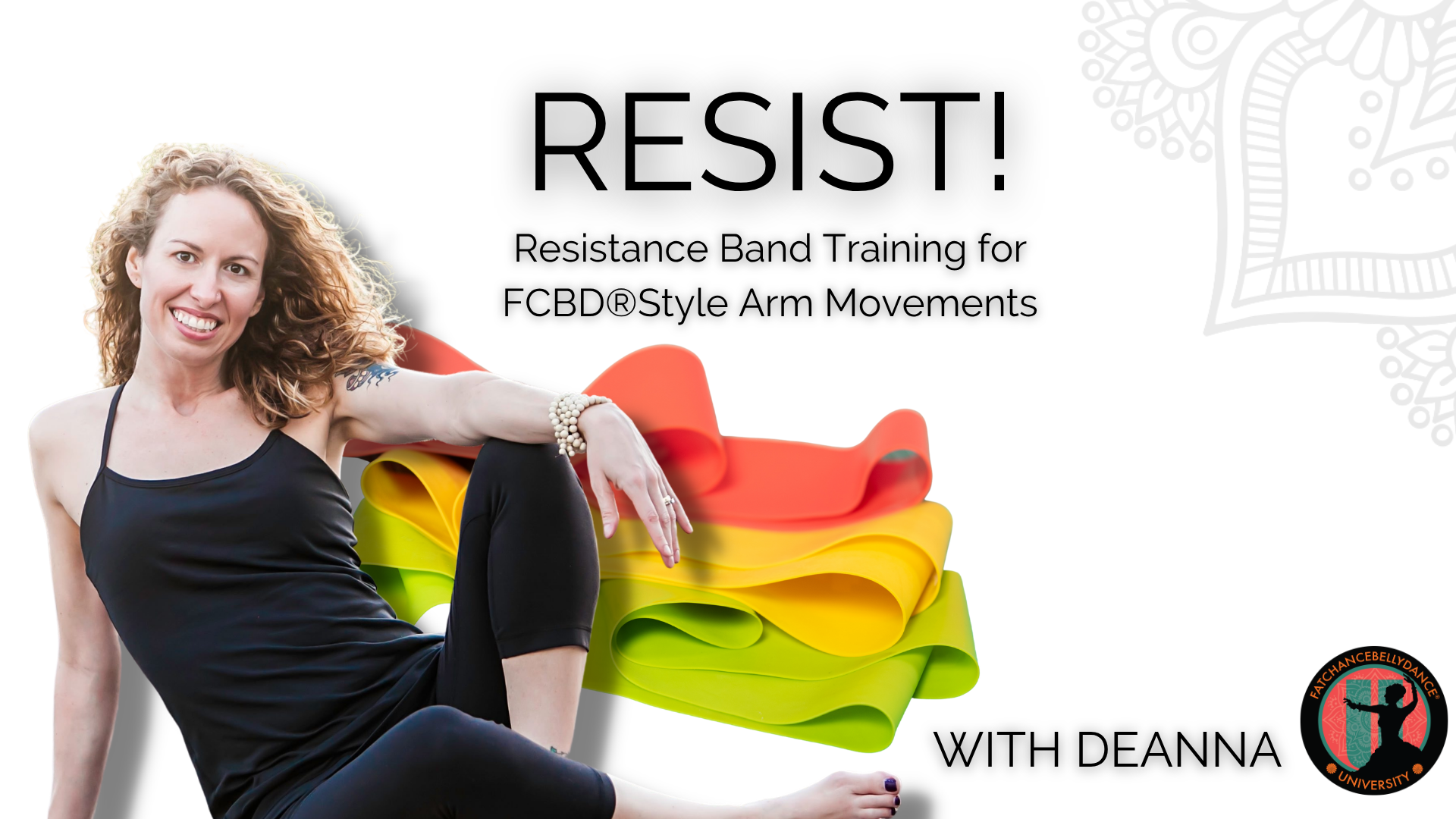
If you really want to feel your lats, I recommend the RESIST class, where we use resistance bands to build strength in our arm postures.
Self-Care for Your Lats
Like any hardworking muscle, the lats appreciate some love. Tight lats can limit your overhead reach and even pull your low back into an exaggerated arch making it harder to isolate your hips for shimmies, twists, etc. A few gentle ways to keep them happy:
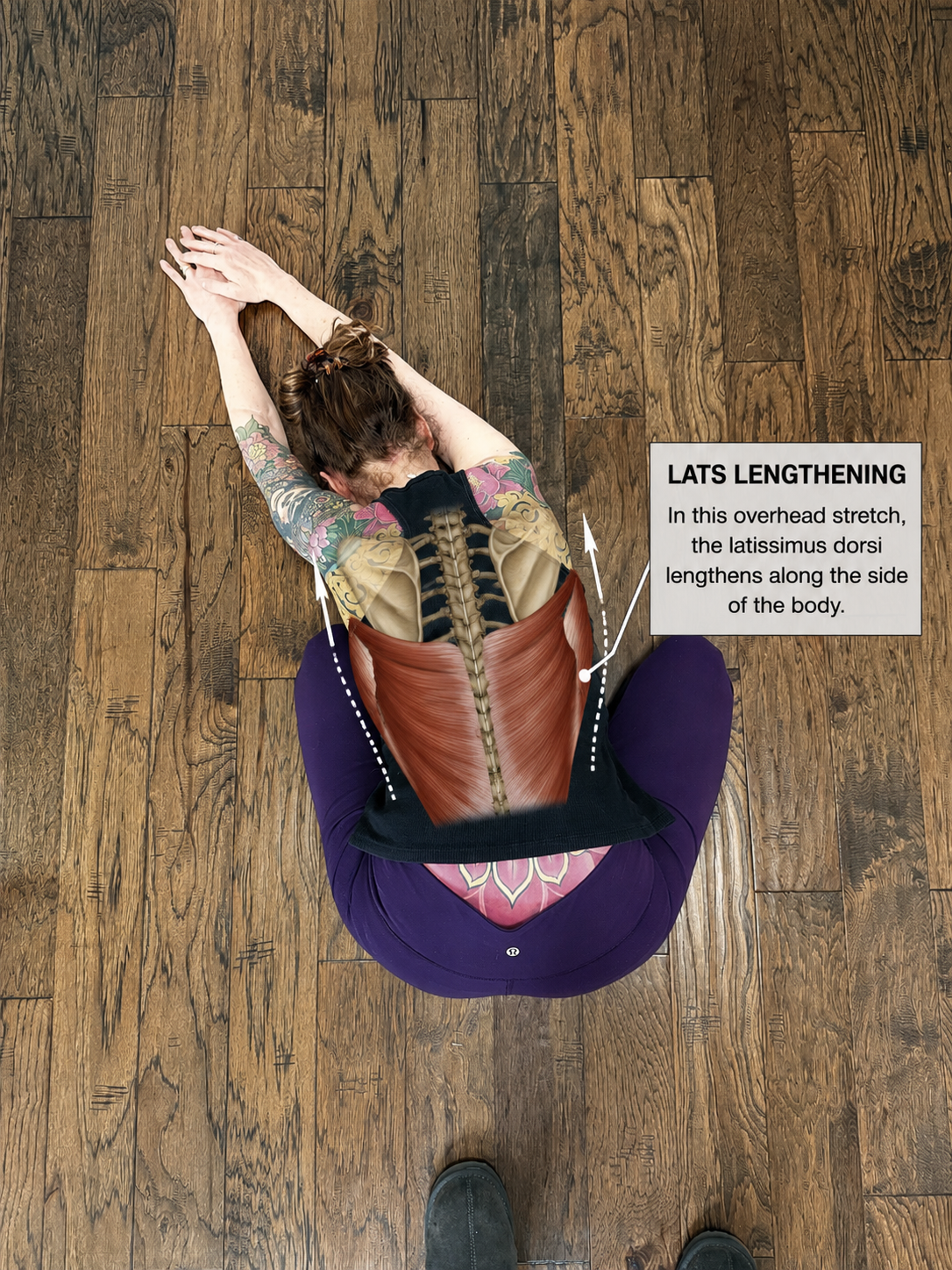
Child's pose with a side reach: From child's pose, walk both hands to one side and breathe into the opposite side of your back. You'll feel a delicious stretch along the whole lat line. Repeat on the other side. Don't be surprised if one side feels different than the other. Our every day habits naturally create imbalances on each side. Another reason cross-training is so essential to keep us dancing longer in life.
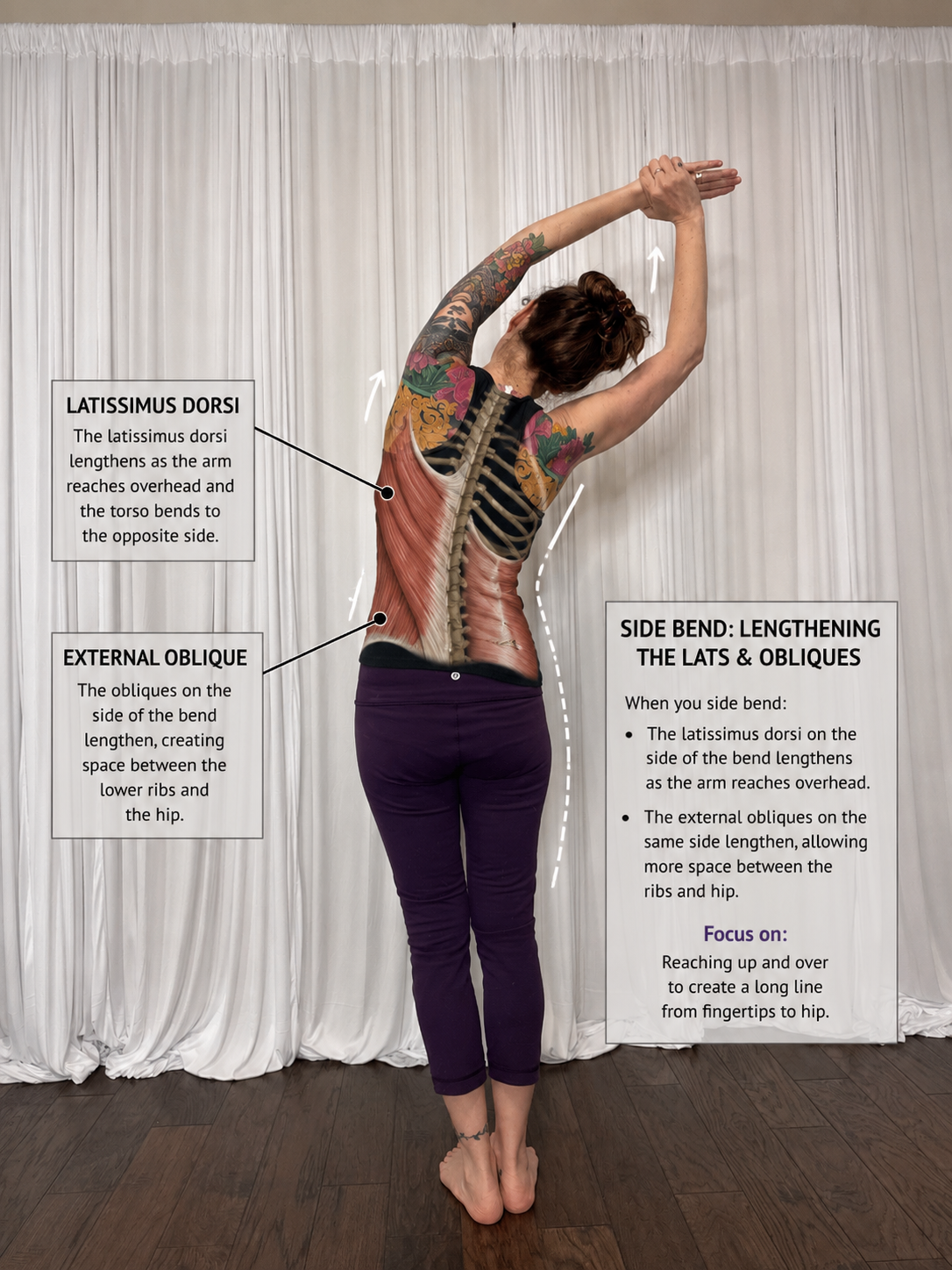
Standing Side Bend: Lengthen your spine, reach your arms overhead while keeping your shoulders relaxed, then reach your arms over to one side and feel the entire opposite side extend. Breathe into this space. This is also excellent for the obliques, which is why I use it in every class warm-up.
Breath work: Because the lats wrap around the ribs, slow, expansive breathing into the sides of your ribcage is a lovely way to release them. Not to mention all the amazing benefits of slow, intentional breathwork.
The next time your arms stay at shoulder height more easily or float through movements with control and grace, take a moment to thank your latissimus dorsi. It's literally got your back.
I'd love to hear how these explorations feel in your practice. And if you want to dive deeper into posture and arm pathways, there are plenty of classes waiting for you on FCBD®U. Your membership gives you full access to a world of continuing education!
If you are interested in learning more about anatomy and how your body moves, I highly recommend the Alignment course. It’s an incredible next step in your dance education.